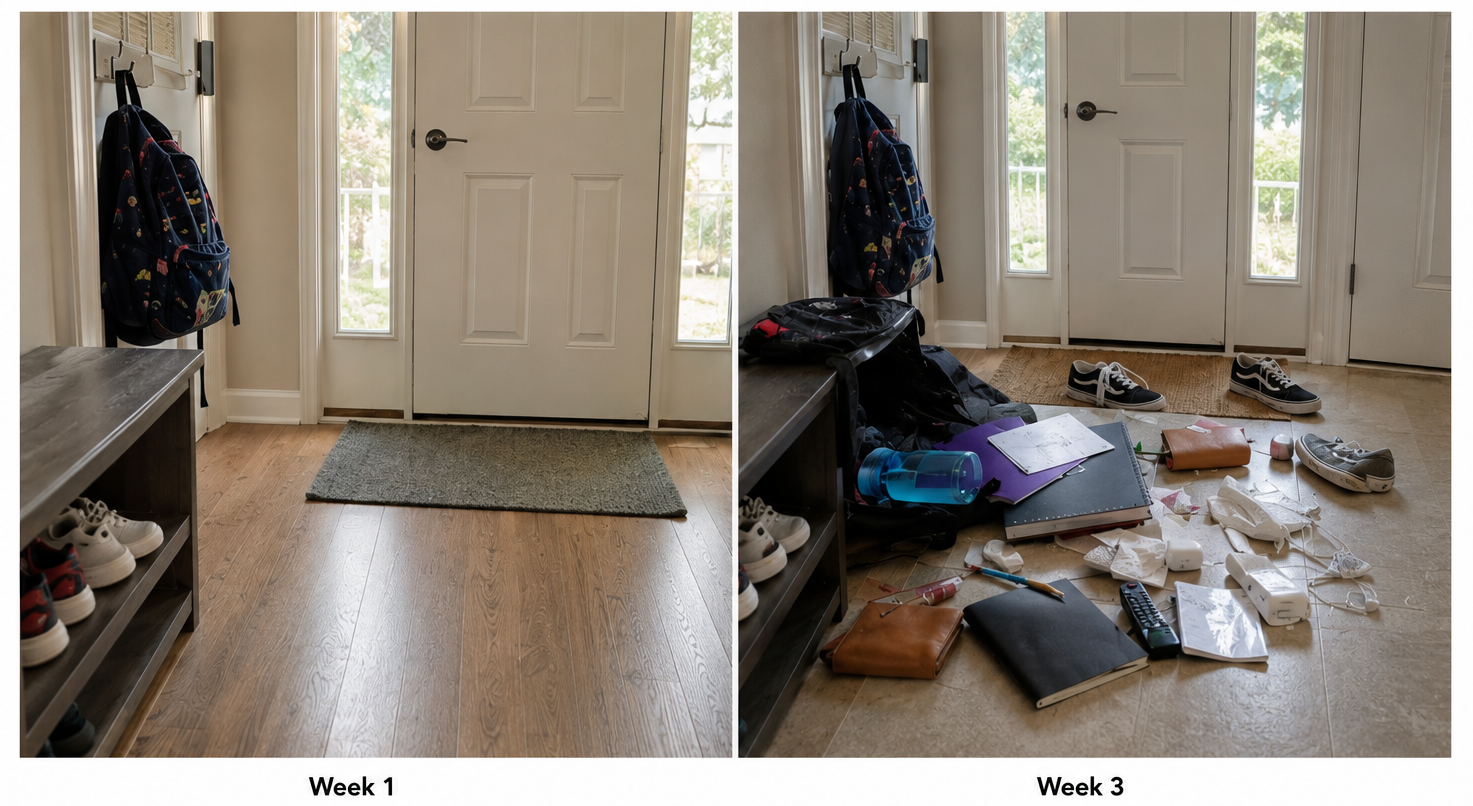
The first week of school went suspiciously well.
New backpack, new shoes, a little first-day nerves, but everyone got out the door. Second week, still holding. You started to exhale. Maybe, you let yourself think, this year is different. Maybe all that prep paid off. Maybe you’ve finally cracked it.
And then week three arrives and the wheels come off the entire wagon.
The meltdown over a pencil. The sudden refusal to get dressed for a shirt that was fine on Tuesday. The kid who was chirpy about their teacher two weeks ago now sobbing that they hate everything and everyone. And your first, gut-level thought is: what happened? We were doing so well. Are we back to square one?
You’re not. This is the September crash, and it is the most predictable, least talked-about part of the whole back-to-school season. Nobody warns you about it because everyone’s busy photographing the first day. But if you know it’s coming, it stops being a mystery and starts being a thing you can actually meet.
Why the crash lands in week three, not week one
Here’s the mechanism, because understanding it changes everything about how you respond.
The first week runs on novelty. New is interesting, and interesting is regulating, a fresh environment gives a neurodivergent brain enough stimulation and enough alertness to power through. There’s also a huge tank of adrenaline underneath it: the nervous system knows something big is happening, so it braces, floods the system, and carries the kid through on borrowed energy.
But novelty wears off. Adrenaline drains. And underneath the smooth surface, a bill has been quietly running up the whole time — the masking bill.
All those weeks of holding it together at school — sitting still, tracking social rules, tolerating the noise and the lights and the lining-up, keeping the big feelings clamped down until they’re somewhere safe — that costs something. Every day. The kid who “did great at school” often spent every ounce of regulation they had at school, which is exactly why it detonates the second they get home to the one place safe enough to fall apart. Multiply that across three weeks and the tank hits empty.
The crash isn’t the problem showing up. The crash is the invoice coming due.
This is not regression. Read that again.
The single most important reframe: your kid is not backsliding. They did not lose the progress. They are not “being manipulative” or “testing you” or “regressing to last year.”
They spent three weeks running a marathon on a battery meant for a sprint, and now the battery is flat. A flat battery looks a lot like going backward, but it isn’t. It’s depletion, and depletion is met with rest and less demand — not with consequences, sticker charts, or a stern talk about attitude.
Punishing a crash is like fining someone for running out of gas. It doesn’t add fuel, it just adds shame to an already empty tank.
How to spot it (so it doesn’t blindside you)
The crash rarely announces itself honestly. It tends to wear disguises: meltdowns wildly out of proportion to the trigger, a return of morning refusal or drop-off tears you thought were behind you, the after-school restraint collapse where a kid who “was fine all day” comes apart the instant they’re in the car. Sometimes it’s physical; stomachaches, headaches, “I feel sick” on Sunday nights, sleep going sideways. Sometimes it’s a kid going quiet and flat instead of loud, which is easy to miss because a quiet kid doesn’t set off alarms.
And, I’ll come back to this, sometimes the person crashing is you.
What actually helps
You don’t fix a crash. You lighten the load until the battery recharges. A few things that genuinely move the needle:
Cut the optional stuff, on purpose. Three weeks in is when the extra commitments pile on; clubs, playdates, the well-meaning enrichment. This is the week to protect white space, not fill it. Fewer demands, more nothing.
Guard the after-school decompression like it’s sacred, because it is. The window right after pickup is not the time for homework, questions about their day, or errands. It’s the time for the nervous system to come down. Snack, quiet, a screen, a slump on the couch, movement, whatever their particular body needs to discharge the day. The debrief can wait; the decompression can’t.
Add co-regulation, don’t subtract it. The instinct when a kid “should be independent by now” is to step back. A crash asks for the opposite. Be the calm they can borrow. Lower your voice, lower the stakes, get closer, not sterner.
Name it out loud, for them and yourself. “The newness has worn off and school is taking a lot out of you right now. That’s real, and it makes sense that you’re running low.” Kids settle when the invisible thing gets named. So do parents.
Expect it next year, and the year after. Once you know the crash is a season, not an emergency, you can plan for a lighter third and fourth week the way you’d plan for anything predictable.
Blindsided is the only part that’s optional.
Your crash counts too
Here’s the part nobody says to the parent: you have been masking and holding and managing for three weeks straight, too. You did the prep, the drop-offs, the forms, the forgotten library book, the emotional weather forecasting for a whole household. Your adrenaline carried you through the launch. And your battery is running on the same fumes theirs is.
So if week three finds you short-fused and weepy and wondering what happened to the competent person who had it together on the first day — nothing happened to her. She’s just at the bottom of the same tank. Your crash is not a character flaw either. It’s an invoice, same as your kid’s, and it’s allowed to come due.
Lower your own bar this week, right alongside theirs. Fewer demands. More nothing. Borrow calm where you can find it.
The crash is not the year falling apart. It’s the year settling in — the loud, messy, entirely normal sound of two nervous systems finally exhaling after holding their breath since the first day of school.
Let them land. Land yourself while you’re at it. Everybody recharges by October.
 RootednChaos
Leave a comment